Operational Risk Management and Decision-Making in Petroleum Facilities in Accordance with ISO 31000:2018
An applied two-day workshop that takes leaders and engineers in petroleum facilities through the full ISO 31000:2018 process on one gas processing case: setting scope, context and risk criteria, building a prioritised risk register with Bow-Tie analysis, choosing a justified treatment, and planning escalation for when assumptions change.
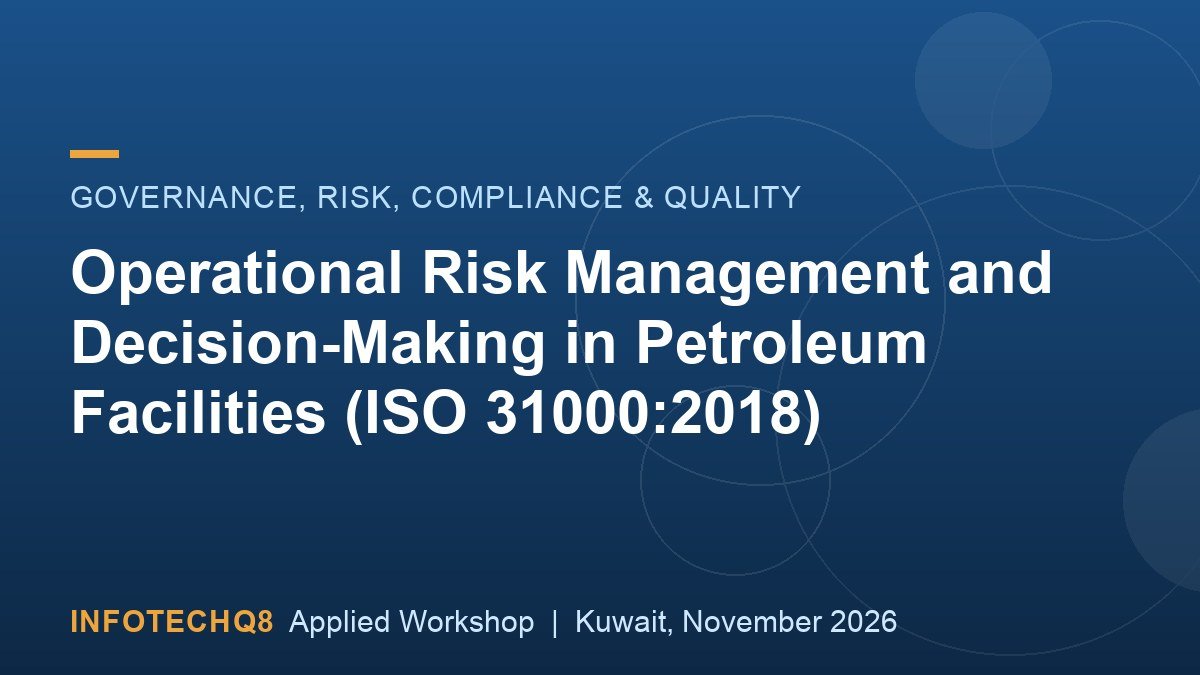
Delivered in Arabic at Jumeirah Messilah Beach, Kuwait, from 8:00 AM to 1:00 PM on both days.
Learning Outcomes
- Explain the relationship between risk management and value protection in petroleum facilities.
- Distinguish between the principles, framework and process of risk management under ISO 31000:2018, and define the roles of leadership and the risk owner.
- Set the scope, context and risk criteria, including risk appetite, for a specific operational decision.
- Build a prioritised risk register, using tools such as Bow-Tie to analyse a critical risk scenario.
- Select an appropriate treatment option, with an owner, resources, deadline and follow-up indicators.
- Design a communication and escalation plan for changing assumptions or an early-warning indicator.
- Prepare an integrated mini risk file (scope, register, treatment plan and follow-up) for an applied case.
Day 1: Value, Language and Criteria
- Why? Protecting value in a high-risk petroleum environment: linking risk management to facility objectives (safety, production, environment, reputation) and how internal and external factors create uncertainty.
- What? A common language and committed leadership under ISO 31000:2018: the eight principles, the framework, and the role of senior leadership in embedding risk awareness and defining roles and responsibilities.
- How? Scope, context and criteria: the assessment scope, stakeholders, assumptions, impact and likelihood criteria, acceptance limits and risk appetite.
Day 2: Assessment, Treatment and Escalation
- How? Risk assessment, from identification to a risk register: identifying, analysing and evaluating risks with Bow-Tie, linking causes to preventive controls and consequences to mitigating controls.
- How? Risk treatment and justified decisions: avoid, reduce, transfer or accept on effectiveness and cost, with a risk owner, resources and KPIs.
- What if? Resilience and escalation when assumptions change: emerging risks such as supply delays or cyber-attacks, and communication, monitoring and escalation when acceptance limits are exceeded.
- Closing: a short presentation from each team, peer review and an individual 30-day commitment.
Training Approach
- Active learning: around 75% of the time in group workshops and hands-on application.
- One integrated case study: a gas processing unit maintenance scenario developed across every module.
- Simulation and role-play: a risk meeting between the leader, the engineer and the risk owner to reach an escalation decision.
- Visual tools and peer review: impact maps, sorting cards and constructive team feedback.
Instructor
Dr. Faisal Fadghoush Bin Shuwaih - executive leader, strategic advisor and retired Brigadier with more than 30 years in leadership, risk, crisis and emergency management, governance and business continuity. PhD in Risk Management, University of Salford (UK).
Location
Courses may be conducted at one of the following hotels in Kuwait:
- Hilton Garden Inn Kuwait – The Avenues
- Hilton Kuwait Resort – Mangaf
- Jumeirah Messilah Beach Hotel & Spa
- Radisson Blu Hotel Kuwait
Or at the client’s premises.
Related Courses

Professional Maximizing Benefit through Risk Management
Understand risk analysis and the mitigation planning process, with the tools to measure risk in an oil and gas setting. Participants work with the risk management framework and dynamic risk registers, applying quantitative and qualitative approaches to real exposures.

Professional Implementation Guidelines to the Legal Aspects of Corporate Governance
Understand your organization's corporate governance framework, including inter-company and intra-group relations, compliance, and the legal regulations around corporate communication. Participants identify where best practice in governance is heading and what it requires.

Inspection and Audit Office Methodology in Government Bodies
Draw a clear line between inspection, auditing and oversight in the public sector. Participants work through the regulatory and legal framework governing these offices, and the detailed responsibilities each function carries in practice.